Surprise: catching the fastest universal emotion.
Surprise is triggered by the unexpected. It is the briefest of all emotions, lasting only a fraction of a second before fading into a neutral state or transitioning into another emotion like fear or joy. Catching it gives you absolute proof that someone didn't know what was coming.
What is Surprise?
Surprise is a unique emotion because of its incredibly short duration. It is a rapid, biological response triggered by an unexpected event, a sudden noise, or a shocking piece of information. Its sole purpose is to clear the mind and prepare the body to absorb new data.
Because it is so fast, surprise is almost always a micro-expression or a very brief macro-expression. The moment the brain processes the new information and decides if it is good or bad, the surprise vanishes, instantly replaced by fear, anger, joy, or relief.
How to recognize surprise on the face
Surprise is characterized by a complete opening of the facial features. The eyes widen, the brows lift high, and the jaw drops, all in a very relaxed, tension-free manner.
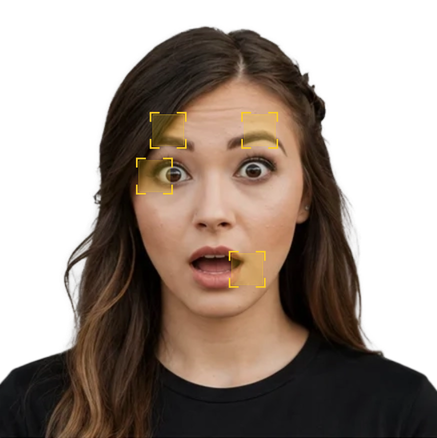
Facial markers to watch
The markers of surprise are large and open, distinct from the tight, contracted movements of other emotions.
Common FACS markers: AU1+2 (full brow raise), AU5 (upper lid raiser), and AU26 (jaw drop).
Unexpected change, prediction error, sudden attention.
"“What is happening?” / “I wasn't expecting this.”"
Surprise functions as a biological reset button. It clears the mind of ongoing thoughts and physically widens the sensory organs (eyes and mouth) to quickly absorb and process new, unexpected information so we can determine our next reaction.
Surprise micro-expressions: the stealth signals
By definition, surprise is naturally fleeting, acting like a micro-expression even when fully realized. However, when someone tries to suppress their surprise—for instance, trying to hide that they didn't know a crucial fact during a meeting—it flashes for just milliseconds.
You might catch a rapid, almost imperceptible brow raise or a tiny jaw drop before they recover their composure. Recognizing this gives you a strategic edge: it proves that the information you just presented was entirely new to them, regardless of what they claim afterward.
What to watch in 300ms
Intensity levels
Surprise varies mainly in magnitude rather than distinct emotional flavors. It ranges from a mild distraction to absolute, jaw-dropping astonishment.
The states of surprise range from mild Distraction to Astonishment and sheer Amazement, depending entirely on how unexpected the triggering event is.
MicroSigns trains you to catch subtle surprise, where the jaw may remain closed but the brows perform a rapid, relaxed arch.




Common confusions
Because surprise is so fast, it is frequently confused with fear, which shares similar facial features but carries a completely different meaning.
Why it's confused
Because both emotions open the eyes wide and raise the brows, they are the most frequently confused pair of facial expressions.
How to tell the difference
Surprise features relaxed, curved brows and a relaxed, open mouth. Fear displays horizontal lip tension (AU20) and brows that are pulled tightly together (AU4) in distress.
Why it's confused
High interest or fascination can also widen the eyes and raise the brows slightly as the person focuses.
How to tell the difference
Surprise is characterized by a completely slack, dropped jaw, whereas interest keeps the mouth engaged, closed, or slightly pursed in thought.
Why it's confused
People sometimes raise their brows high and drop their jaw to mock, act incredulous, or show sarcastic disbelief.
How to tell the difference
True surprise is fleeting, involuntary, and lasts less than a second. Performative skepticism or fake surprise is held much longer on the face for theatrical effect.
⚡ Train yourself to differentiate these signals on MicroSigns.
Train surprise recognitionHow MicroSigns trains surprise detection
Since surprise is naturally the fastest emotion, MicroSigns pushes your recognition speed to the absolute limit. You will learn to spot the relaxed, curved brows and dropped jaw of true surprise and immediately distinguish it from the tense, stretched features of fear.
By training on rapid-fire sequences, your brain will build the reflex to separate genuine, fleeting surprise from the prolonged, fake displays people use to manipulate conversations.
The Flash
You are exposed to an expression for a fraction of a second, mimicking the natural speed of surprise.
Forced Choice
You must instantly categorize the emotion, deciding if it was surprise, fear, or a fake display.
Baseline Comparison
Compare the expression to the neutral face to spot the relaxation in the jaw.
Targeted Drill
If you consistently confuse surprise with fear, the system drills you on differentiating lip tension.
Frequently Asked Questions about Surprise
How long does true surprise last?
Genuine surprise rarely lasts more than a second. Once the person's brain evaluates the surprising event (is it good, bad, or dangerous?), the emotion immediately transitions into fear, joy, anger, disgust, or relief.
Can a micro-expression of surprise reveal a lie?
Not directly, but it can reveal hidden knowledge. If you present a piece of evidence and the person holds a long, drawn-out, theatrical expression of surprise, it's a strong indicator they are faking it and already knew about it. Genuine surprise is always fast.
Why do my eyebrows go up when I'm surprised?
Raising the eyebrows pulls the eyelids up, physically widening the eyes. This allows more light in and increases your field of vision, helping you quickly identify whatever caused the surprise.
Is surprise a positive or negative emotion?
Surprise is the only neutral emotion. It is completely valenceless until the brain determines what caused the surprise, at which point it shifts into a positive or negative state.
Think you can catch surprise in 300ms?
Move from theory to practice. Start with a free perception assessment session, then unlock the full catalog with Founder Access.