Fear: recognizing the rapid signals of threat.
Fear is a primal survival mechanism triggered by perceived danger. It flashes on the face to widen our field of vision and prepare the body to react. Often confused with surprise due to its speed, mastering the detection of fear is essential for reading a room accurately.
What is Fear?
Fear is an anticipation of danger or threat, preparing the body to freeze, fight, or flee. It is one of the most critical emotions for our survival. When we experience fear, blood flow is redirected to large muscle groups (like our legs for running), and our facial features literally open up to gather more sensory information.
In modern, non-physical contexts like business or social interactions, fear often manifests as anxiety or apprehension about losing a deal, looking foolish, or making a mistake. These psychological threats trigger the exact same facial muscles as a physical threat, often flashing as lightning-fast micro-expressions.
How to recognize fear on the face
Decoding fear requires differentiating it from surprise. While both emotions cause the eyes to widen, fear is characterized by distinct horizontal tension in the lips and a specific gathering of the eyebrows.
Facial markers to watch
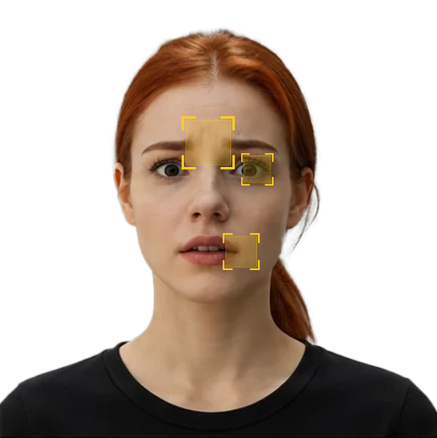
Fear pulls the facial features upward and outward in a state of high tension. Look for these specific muscle activations.
Common FACS markers: AU1+2+4 (brows), AU5 (upper lid), and AU20 (lip stretcher).
Potential danger, threat, uncertainty, need for protection.
"“Something is wrong.” / “I need to protect myself.”"
Fear focuses our attention entirely on a threat, preparing the body to react. The widened eyes physically increase our field of vision to gather more information, while the distinct facial expression acts as an alarm bell, instantly alerting others in our group to impending danger.
Fear micro-expressions: the stealth signals
Fear micro-expressions are incredibly fast flashes, often leaking when someone feels suddenly intimidated, uncertain, or caught off guard, but tries to project confidence. Because fear demands an immediate physiological response, it is very hard to suppress entirely.
You might only see a split-second horizontal stretching of the lips (AU20) or a quick raise and drawing together of the eyebrows before the face returns to a neutral mask. Spotting this allows you to step back, reassure the person, and re-establish safety in the conversation.
What to watch in 300ms
Intensity levels
Fear scales rapidly based on the immediacy and severity of the threat. In most everyday interactions, you will be looking for the subtle signs of apprehension or nervousness, not absolute terror.
Fear covers emotional states including: Trepidation, Nervousness, Anxiety, Dread, Desperation, Panic, and Terror.
MicroSigns trains you to look for the horizontal lip stretch (AU20), which is often the most reliable subtle indicator of apprehension.



Common confusions
Fear is notoriously difficult to isolate because it shares key facial muscles with other high-energy emotions, most notably surprise.
Why it's confused
Both emotions open the eyes wide and raise the eyebrows, making them the most frequently confused pair of facial expressions.
How to tell the difference
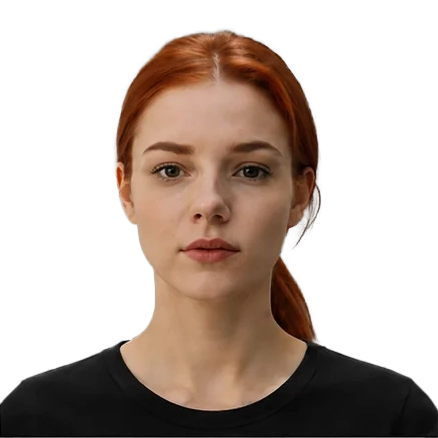
In fear, the eyebrows are drawn together (not just up), the lower eyelids are tense, and the lips are stretched horizontally. Surprise features relaxed, curved brows and a naturally dropped, relaxed jaw.
Why it's confused
Both emotions involve the inner eyebrows pulling upward and together (AU1+4).
How to tell the difference
Fear is a high-energy state with wide, tense eyes (AU5). Sadness is a low-energy state where the eyes droop and the lip corners pull downward.
Why it's confused
The anticipation of physical pain can look exactly like fear, causing the face to tense up.
How to tell the difference
Actual pain usually involves tightly closed eyes (AU43) and a wincing motion to protect the face, rather than the wide-eyed, information-gathering look of pure fear.
⚡ Train yourself to differentiate these signals on MicroSigns.
Train fear recognitionHow MicroSigns trains fear detection
Fear is fast, and distinguishing it from surprise requires split-second precision. MicroSigns trains your eye to instantly catch the subtle horizontal lip stretch (AU20) and the specific, tense brow configuration of fear.
By presenting you with rapid sequences comparing fear to surprise, your brain develops a reflex to automatically check for lip tension, preventing critical misinterpretations in real-world scenarios.
The Flash
You are exposed to an expression for a fraction of a second, mimicking a real micro-expression.
Forced Choice
You must instantly categorize the emotion, deciding between fear and surprise.
Baseline Comparison
Review the expression against the neutral face to spot the exact muscle tension.
Targeted Drill
If you consistently confuse fear with surprise, the system generates drills focused on mouth tension.
Frequently Asked Questions about Fear
Why is fear so often confused with surprise?
Because they share key facial muscles: raised eyebrows and widened eyes. Surprise is also the briefest emotion, and if the surprising event is evaluated as threatening, it instantly transitions into fear, blending the signals.
How do you respond to a micro-expression of fear?
Acknowledge the unspoken concern by providing reassurance. Do not pressure the person. Slow down the pace, clarify information, and make the environment feel safer.
Can fear be disguised as anger?
Yes. People often use anger as a defensive mask to cover up underlying fear or vulnerability. A sharp observer can sometimes catch a micro-expression of fear right before the mask of anger drops into place.
Are the signs of fear universal?
Yes. The widening of the eyes to increase the visual field and the rapid inhalation of air (stretching the lips) are deeply evolved biological responses present in all human cultures.
Think you can catch fear in 300ms?
Move from theory to practice. Start with a free perception assessment session, then unlock the full catalog with Founder Access.