Anger: how to recognize the facial signals before they escalate.
Anger is an approach emotion that often appears when a boundary is crossed, a goal is blocked, or unfairness is perceived. Knowing how to detect its early facial markers allows you to defuse conflicts and adjust your negotiation strategy before a situation explodes.
What is Anger?
Anger is one of the most powerful and action-oriented of the seven universal emotions. Unlike sadness or fear, which often lead to withdrawal, anger is an 'approach' emotion. It physically and psychologically prepares us to confront a threat, overcome an obstacle, or assert dominance when we feel a boundary has been violated.
In professional and social settings, raw anger is heavily stigmatized. As a result, people frequently attempt to mask their frustration. However, because anger triggers immediate physiological responses—like a spike in heart rate and blood rushing to the hands—it almost inevitably leaks onto the face through micro-expressions, particularly around the brows and lips.
How to recognize anger on the face
Decoding anger requires looking for specific areas of tension. While an explosive rage is obvious to everyone, recognizing the early, subtle stages of anger relies on spotting the involuntary tightening of the facial muscles, long before the person raises their voice.
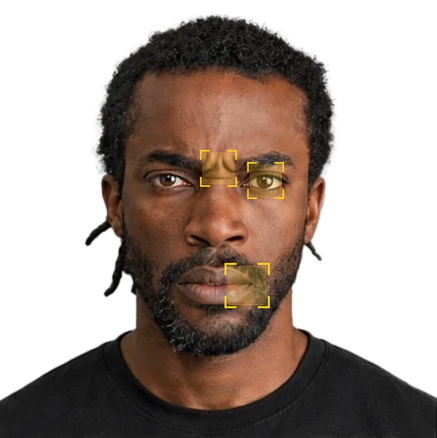
Facial markers to watch
True anger activates a highly specific combination of facial muscles that create a hard, focused, and aggressive appearance. Here are the primary facial markers identified by Paul Ekman's research.
Common FACS markers: AU4 (brow lowerer), AU5/AU7 (eyelid tension), AU23/24 (lip tension).
Obstruction, injustice, perceived threat, physical or psychological boundary crossed.
"“Stop.” / “Move.” / “This is unacceptable.”"
The primary message of anger is, “Get out of my way!” It communicates a wide range of states, from mere dissatisfaction to physical threats. Socially, it signals to others that a limit has been reached and demands an immediate change in behavior or circumstances.
Anger micro-expressions: the stealth signals
Anger doesn't always express itself explosively. When a person tries to conceal their irritation in a professional setting, or as the emotion just begins to form, it manifests as micro-expressions. These involuntary flashes last less than half a second—often around 300 milliseconds—making them incredibly difficult to catch without dedicated training.
Spotting these stealth signals gives you a massive advantage. If you notice a quick lip press when you state your price during a negotiation, you instantly know you've hit a pain point, even if the person's tone remains perfectly polite. It allows you to pivot your strategy and address the unvoiced objection before it derails the deal.
What to watch in 300ms
Intensity levels
Real-world anger rarely looks like the extreme, shouting faces seen in stock photos. Emotion operates on a gradient. Training your perception means learning to recognize anger when it is merely a whisper of annoyance, not just when it has escalated to full-blown fury.
From least intense to most intense, the emotional states of anger evolve on a precise scale: annoyance, frustration, exasperation, argumentativeness, bitterness, vengefulness, and finally uncontrollable fury.
MicroSigns always tests your perception against a neutral baseline, ensuring you aren't just reacting to someone's naturally intense resting face.




Common confusions
Because facial muscles are shared across different emotions, anger is frequently misinterpreted. Recognizing the subtle differences is the core of MicroSigns training.
Why it's confused
Both emotions are hostile and can feature lowered brows and an intense gaze. They both signal rejection or opposition to what is happening.
How to tell the difference
Disgust is uniquely defined by the wrinkled nose (AU9) or the raised upper lip (AU10), which mimics the action of expelling bad food. Anger relies heavily on lip pressing (AU24) and eyelid tension without the nose wrinkle.
Why it's confused
A highly concentrated person naturally tends to furrow their brows (AU4) to focus, which can mistakenly make them look angry or unapproachable.
How to tell the difference
Concentration generally only involves the brow area. It does not feature the intense tightening of the lower eyelids or the aggressive lip pinching typical of true anger.
Why it's confused
Although both are negative, hostile emotions that often occur together during arguments, their facial signatures are entirely different.
How to tell the difference
Anger is a symmetrical emotion—both sides of the face react equally. Contempt is inherently asymmetrical, characterized by a single lip corner being pulled back and slightly up.
⚡ Train yourself to differentiate these signals on MicroSigns.
Train anger recognitionHow MicroSigns trains anger recognition
Reading about the corrugator muscle will not help you during a heated, real-world confrontation. You do not build reflexes by memorizing definitions; you build them through high-speed visual repetition.
The MicroSigns training arena is designed to turn your theoretical knowledge of anger into a subconscious visual reflex, forcing your brain to process facial data faster than the conscious mind can overthink it.
The Flash
You are exposed to a face displaying subtle anger for as little as 300 milliseconds.
Forced Choice
You must immediately categorize the emotion under time pressure, preventing analytical guessing.
Baseline Comparison
The system reveals the person's true neutral face alongside the expression so you can spot the exact muscle deviations.
Targeted Drill
If you consistently confuse anger with disgust, the engine builds a custom drill focused exclusively on that pair.
Frequently Asked Questions about Anger
Can a person completely hide their anger?
Consciously, yes, a person can attempt to neutralize their face. However, muscular 'leakage' (micro-expressions) very often occurs around the brows or lips for a fraction of a second, before the conscious brain manages to repress the signal.
What should I do if I spot an anger micro-expression during a discussion?
The golden rule is never to brutally confront the person by saying 'I know you are angry.' Use the information to adjust your behavior: slow down the pace, ask open-ended questions, and give your interlocutor space.
Why is it so important to detect anger quickly?
Anger is a direct precursor to action. Spotting its weak and early signals allows you to anticipate a blockage, defuse a tense negotiation, and avoid a communication breakdown before the situation becomes unrecoverable.
Are the signs of anger the same in all cultures?
Yes. While cultures dictate *when* and *how strongly* it is appropriate to display anger (display rules), the actual physiological muscle movements on the face are universal and hardwired into our biology.
Does a lowered brow always mean anger?
No. Lowered brows can also indicate deep concentration, confusion, or even physical pain. This is why you must look for clusters of markers, such as the addition of pressed lips and tense eyelids.
Think you can catch anger in 300ms?
Move from theory to practice. Start with a free perception assessment session, then unlock the full catalog with Founder Access.