Sadness: how to spot the silent signals of loss.
Sadness is characterized by withdrawal and low energy following a loss or disappointment. Its facial markers can be incredibly subtle, relying heavily on a specific, difficult-to-fake inner eyebrow muscle. Catching this signal allows you to offer empathy when it is needed most.
What is Sadness?
Sadness is a universal response to loss, disappointment, or helplessness. Unlike anger or fear, which are high-energy emotions that prepare the body for action, sadness is a low-energy state. It slows us down, forcing us to withdraw and process the emotional pain we are experiencing.
Because showing sadness makes us vulnerable, many people try to suppress it, especially in professional environments. However, the true physiological signature of sadness involves muscles that are notoriously difficult to control voluntarily, making it one of the most reliable emotions to read if you know what to look for.
How to recognize sadness on the face
Decoding sadness requires looking for a general loss of facial muscle tone, combined with one highly specific, reliable marker: the upward and inward pull of the inner eyebrows.
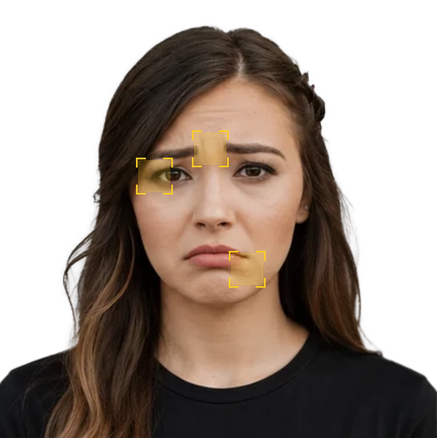
Facial markers to watch
The face of sadness generally drops and loses tone, but the inner eyebrows perform a very specific, active movement.
Common FACS markers: AU1 (inner brow raiser) often with AU4, and AU15 (lip corner depressor).
Loss, helplessness, withdrawal, need for support.
"“I have lost something important.” / “I need comfort.”"
Sadness slows us down, allowing time and cognitive resources to process a loss or significant disappointment. Socially, displaying sadness signals vulnerability and a need for help, effectively eliciting empathy, comfort, and support from our community.
Sadness micro-expressions: the stealth signals
Sadness is one of the hardest micro-expressions to fake and easiest to miss. It leaks when someone experiences a sudden pang of disappointment, regret, or empathy but tries to maintain a stoic, professional facade.
The most reliable stealth signal is the inner brow raise (AU1)—a tiny, involuntary pulling up and together of the inner eyebrows that vanishes almost instantly. Catching this flash during a difficult conversation tells you that the person is genuinely hurt or disappointed, not just angry or indifferent.
What to watch in 300ms
Intensity levels
Sadness can be a quiet, lingering feeling of disappointment or a loud, consuming state of grief. Training your eye to catch subtle sadness is crucial, as people rarely display intense grief in everyday interactions.
The intensity of sadness depends on the magnitude of the loss. The spectrum includes: Disappointment, Discouragement, Distraughtness, Resignation, Helplessness, Hopelessness, Misery, Despair, and Grief.
MicroSigns trains you to detect the AU1 inner brow raise even when the rest of the face remains completely still.




Common confusions
Because sadness involves a general relaxation and dropping of facial features, it can easily blend into a neutral state.
Why it's confused
When people are very tired or deeply relaxed, their facial features drop naturally, which can look like a frown or sadness.
How to tell the difference
The key differentiator is the inner brow raise (AU1+4). Fatigue drops the face, but true sadness actively pulls the inner eyebrows up and together. This is a movement that is very difficult to perform voluntarily.
Why it's confused
Both emotions cause the inner eyebrows to pull together and upward.
How to tell the difference
Fear is a high-energy, tense state accompanied by wide, glaring eyes (AU5). Sadness is characterized by low energy, drooping upper eyelids, and a downward pull of the lip corners.
Why it's confused
Disappointment is a milder state on the sadness spectrum, making them visually similar.
How to tell the difference
While very similar, pure sadness is deeper and longer-lasting. Mild disappointment might just show as a brief lip pout, a sigh, or gaze aversion without the full brow involvement.
⚡ Train yourself to differentiate these signals on MicroSigns.
Train sadness recognitionHow MicroSigns trains sadness detection
MicroSigns trains you to detect the subtle, hard-to-fake inner brow raise. Because sadness involves a loss of facial tone rather than active tension, it can be incredibly discreet and easily missed by the untrained eye.
The training drills will force you to differentiate between a truly neutral, relaxed face and one displaying the micro-markers of hidden distress, sharpening your empathy and situational awareness.
The Flash
You are exposed to an expression for a fraction of a second, forcing rapid recognition.
Forced Choice
You must decide if the face is showing sadness, fear, or just neutral fatigue.
Baseline Comparison
Compare the expression to the neutral baseline to confirm if the inner brows actually moved.
Targeted Drill
If you miss the subtle signs, the system generates drills focused exclusively on the brow region.
Frequently Asked Questions about Sadness
Can someone fake sadness?
They can easily fake the downward turn of the mouth (a frown), but very few people (less than 15%) can voluntarily control the inner eyebrow muscles required for genuine sadness. If the brows don't move, the sadness is likely performative.
What does a micro-expression of sadness indicate in a negotiation?
It often indicates that the other party feels they are losing something valuable, or that a proposed term is genuinely painful to them. It's a signal to tread carefully, hold your position, but perhaps show empathy in your delivery.
Why is the inner brow raise so hard to fake?
The corrugator and frontalis muscles operate involuntarily in response to genuine emotional distress. Our brains simply aren't wired to easily fire them on command without practice.
Is crying always a sign of sadness?
No. People can cry from extreme joy, intense anger, or overwhelming relief. You must look at the underlying facial muscle movements to determine the true emotion.
Think you can catch subtle sadness in 300ms?
Move from theory to practice. Start with a free perception assessment session, then unlock the full catalog with Founder Access.